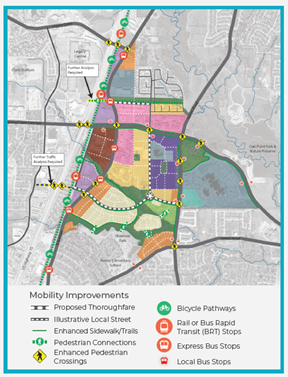
The Oak Point area is in the northeastern portion of the Dallas-Fort Worth Metropolitan Area. It is situated in east Plano and is
entirely within Collin County. The site covers 730 acres and provides access to Oak Point Park & Nature Preserve, Collin College, Plano Event Center, and the DART rail transit network. The community is along the region's historic growth corridor, US Highway 75, which runs from downtown Dallas north through Collin County into Oklahoma. The City of Plano is a prime location for businesses and residents due to its location on US Highway 75. Although Plano is a popular place to live and work, the City is quickly becoming landlocked because of surrounding incorporated areas. In December 2016, the City's leadership initiated a planning policy known as Envision Oak Point. The new policy serves as a tool to evaluate Oak Point's development proposals and future zoning requests; plan for future infrastructure needs – in and around this area; and communicate the area's 30-year vision for short, mid, and long-term change.
The Envision Oak Point plan exemplifies two of the recommended Principles of Development Excellence for guiding development in North Central Texas:
- Implementation: achieving the region's vision by adopting compatible comprehensive plans and ordinances for cities, and consistent investment plans for regional systems, involving citizens and stakeholders in all aspects of these planning processes.
- Development Diversity: meeting the needs of changing markets by providing a mix of development options and land use types in communities throughout the region.
Implementation: Stakeholder groups from the surrounding neighborhoods, businesses, faith-based organizations, and schools were involved in the planning process from the beginning. These stakeholder groups met with the City's planning staff and consultants several times during the planning process to share their feedback. The planning team used individual stakeholder interviews, pop-up booths, surveys, social media platforms such as Twitter, Facebook, and Nextdoor, design workshops, and public presentations to obtain community feedback and connect interested citizens to past and upcoming events. A community vision map was developed from the community engagement process to guide the future land uses, social amenities, and transportation improvements for the Oak Point area. The community vision map considers data from pre-planning research, scenario planning, and community engagement activities and responses. Development patterns such as rural preserve, small lot subdivision, and commercial nodes were identified through the community engagement process. The Envision Oak Point Plan's community vision framework informs the goals, strategies, and actions that address land use and development patterns, mobility, parks, recreation, open space, placemaking and community design, environment and infrastructure, and the economic community. The goals, policies, and actions in this plan provide a roadmap for the City of Plano to follow to achieve the desired development in Oak Point.
Development Diversity: The Envision Oak Point plan includes a mix of development options and land-use types to ensure the Oak Point area can adapt to changing markets. The Oak Point plan development types are driven by key themes identified by the stakeholder and public input. Those themes create a shared vision for the community, including diverse community patterns, unique character, connected community, environmentally resilient, and inclusive open spaces. Some development types in the plan include mixed-use activity centers, transit-ready areas, commercial nodes, and rural preserve.
Sub-Area strategies recommended for Oak Point are divided into four quadrants: Northern, Eastern, Southern and Western quadrants. Sub-Area strategies provide recommendations to shape the connected and economically resilient development patterns tailored to the Oak Point area. The purpose of the recommendations for the four sub-areas is to describe and illustrate development principles. The southern quadrant contains Oak Point's traditional neighborhoods. It is proposed to provide bicycle connections to parks and schools, including a broad range of single-family housing, maintain access to natural corridors, and establish east and west collector streets. The eastern quadrant is Oak Point's social hub, which is designed to be pedestrian-friendly. This hub supports opportunities for living, working, and dining. The northern quadrant is Oak Point's neighborhood adjacency zone and recommends preserving land north of spring creek parkway, enhancing pedestrian connectivity, and supporting investment in Plano mix square Mall area. Finally, in the western quadrant, Oak Point's employment center hopes to establish a rail trail to connect the site to downtown Plano better, encourage the long-term transition from big box retail to light commercial uses, and preservation of land between split trail and Avenue K.
Conclusion: Envision Oak Point is intended to guide change that will enhance the community, accommodate needed mobility improvements, and encourage reinvestment in Oak Point. The plan explains Plano's detailed process, which highlights the community and broadly addresses future development patterns. The Envision Oak Point plan emphasizes community involvement and provides a straightforward, flexible path for implementation that involved citizens and stakeholders in all aspects of these planning processes. By adopting and implementing comprehensive plans and ordinances, Plano continues its investment in its community and the region. Development diversity is shown in the Envision Oak Point sub-area strategies for the Northern, Eastern, Southern and Western quadrants. Each quadrant recommendation was developed to guide development that will meet the needs of changing markets by providing a mix of development options and land use types in communities throughout the North Central Texas region. As a result, the Envision Oak Point plan is a shining example of development excellence principles found in the North Central Texas Region.