In the state of Texas, solar power is becoming a more widely available and sought after means to power our infrastructure. Over the past few decades, Texas has risen to become the 4
th highest state for solar power employment in America, boasting 565 solar companies throughout the state. Some North Central Texas school districts have chosen to follow suit. Over the past few years, several independent school districts across Texas have been making steps toward equipping their schools with solar technology. With a variety of benefits, including cost savings and educational value to students, these school districts have been able to pave the way for other schools across the state.
Benefits of Solar Installations on Schools
Almost all the schools that have installed solar panels and solar arrays have found great success with their projects. Some schools reported several benefits of the solar projects they brought to campus, including: savings on energy costs, educational opportunities, environmental benefits, and energy reliability.
Funding
While the cost may run high for projects like these, some schools have found ways to gain funding for their solar installations. For example, many independent school districts have found funding via State Energy Conservation Office (SECO) Grants and Loans.
Solar Power in Action
Throughout the state of Texas, many schools and independent school districts are making a strong case for why more schools should consider investing in solar power. The following are some of those schools, and the projects that they have invested in.
Bridgeport ISD- Bridgeport High School
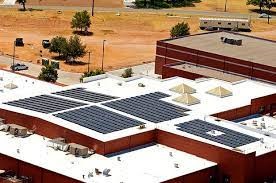
Bridgeport ISD is located in Bridgeport, Texas, and is home to four different campuses that serve Bridgeport, Lake Bridgeport, and Runaway Bay, Texas. Bridgeport started their solar project in 2010 with a grant from the State Energy Conservation Office (worth $900,000 and a $180,000 match) and began constructing in 2011. They created a 170-kW rooftop solar array built on a new energy efficient roof at Bridgeport High School, which features a cool-white membrane roof, a high efficiency chilled water system, and energy-efficient fluorescent lighting. Since the construction of the solar array, Bridgeport High School has seen a 30-40% reduction in their annual utility expenses.
Carroll ISD- Carroll Middle School and Carroll High School
Carroll ISD has 11 campuses throughout Southlake and parts of Grapevine, Colleyville, and Westlake, TX. They started in 2011 with the construction of Carroll Middle School
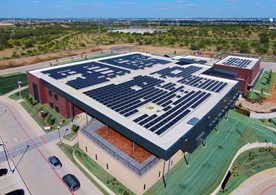
, which features a 450-kW solar array which covers 70,000 square feet of rooftop, making it one of the largest school solar arrays in the state of Texas. After being funded $2.0 million from a SECO grant, Carroll ISD was
even able to gain a rebate valued at $550,000 afterwards. On top of this project, Carroll ISD upgraded the roof of Carroll High School to add a 500-kW solar array to the rooftop in 2014.
Coppell ISD- Richard J. Lee Elementary
Coppell ISD has 16 different campuses throughout Coppell, Grapevine, Irving, Valley Ranch, Dallas, and Lewisville, TX
. They are home to the state’s first LEED Gold, net-zero elementary school at Richard J. Lee Elementary. Retrofitted in 2014, Richard J. Lee Elementary can sustain itself completely by producing as much energy as it uses via wind and solar energy generation.
Irving ISD- Lady Bird Johnson Middle School
Irving ISD is located in Irving, TX, and has over 40 campuses. Irving ISD has their own net-zero middle school in Lady Bird Johnson Middle School, which is actually the nation’s largest net-zero middle school and the first ever net-zero middle school in the state of Texas. At roughly 150,000 square feet, the facility incorporates energy reducing systems with goals to reduce energy consumption by over 50% from the traditional school model. The school is designed as a teaching tool for all of Irving ISD to be integrated into the science curriculum. Overall, the school’s goal is to reduce energy consumption by over 50% compared to an average school.
The Details
Attention to detail, thorough processes and dedication are a few components that each school had to implement for their solar project and prove it worthy. For example, one major piece of each project is the energy that the project will produce for the school. In Bridgeport ISD, their project only produces a little over 235,000 kW per year, while Coppell produces over 500,000 kWh per year. Meanwhile, both Irving ISD and Carroll ISD get over 800,000 kWh per year from their respective projects. Bridgeport and Coppell also have a smaller PV capacity of 170 kW and 358 kW respectively, while Carroll ISD and Irving both boast a PV capacity of over 500 on each of their projects. While output and capacity are obviously crucial to a solar power project, it is important to note that some of these projects may fit the size of their campus better than others or may even be what the district could afford. While Bridgeport may have a lower energy output and capacity, the total cost for their project only summed up to $900,000, compared to other schools who had costs in the multi-millions. Overall, while some independent school districts are still skeptical about the feasibility of solar power in their schools, these schools have managed to pave the way and show the rest of the region how doable it can be.
Sources:
https://www.gosolartexas.org/school-district-case-studies
https://www.gosolartexas.org/getattachment/0f96a565-6ef1-4872-ac78-9cce5491400d/bridgeport_isd_case_study.pdf
https://www.gosolartexas.org/getattachment/5ae09210-42d0-490d-a9e5-306d06a98858/carroll_isd_case_study.pdf
https://www.gosolartexas.org/getattachment/d9fd9725-7f3a-4049-9a6f-f9d686028db0/coppell_isd_case_study.pdf