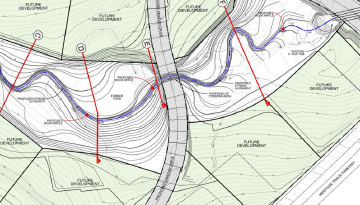
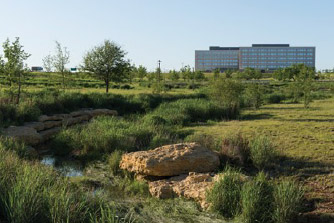
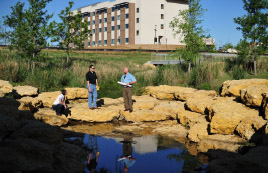
To prepare the Upper Whites Branch Stream in Fort Worth, Texas for development, Peloton Land Solutions had to eliminate a 50-year-old stock pond and ephemeral stream. If the pond’s dam were to breach, two major highways would be over-topped by the water and nearby residences would have been flooded. To prevent such a disaster, the project team chose to bring the stream channel back to its natural form—all the way down to the limestone formations. The design team took careful effort to make the formations look like those naturally occurring in the environment, while also serving as grade control for the project area.
The Upper Whites Branch Stream and Prairie restoration began in 2012. The 14 acre site had a 9 acre pond that was built in the 1960s. The developer wanted to keep the pond but for liability reasons determined that removing the pond dam & restoring a natural stream channel through the site was the most desirable option. Peloton Land solutions was hired to restore the ephemeral stream on the North Fort Worth Prairie in the Alliance Town center mixed-use development. Peloton focused on geomorphologic factors such as gradient, sinuosity, capacity, and sediment transport characteristics. Ecological factors included native vegetation and wildlife habitat potential. They used the 1900s Hill survey description as reference for soils and plants of Blackland/Fort Worth Prairie habitat in order to replicate conditions.
Ephemeral streams are streams that typically only flow briefly during and following a rain event or a period of rainfall. About 60% of streams in the United States only flow after rain or storm events. These streams are very important to the downstream waters, as they move nutrients, sediments and debris, and provide connectivity within the watershed. Ephemeral streams provide many of the same functions and values as rivers and larger streams. The arid Southwest and Midwest portions of the country have the highest number of seasonal and rain-dependent streams.
Ephemeral Streams are known for their pronounced width. The lower reaches of ephemeral streams are noted for having particularly flat bed topography; the beds of single-thread streams are often near horizontal and planar. Rapidly receding flows can destroy or modify bedforms with ripples, dunes, and anti-dunes that may develop at greater flow depths. Bedforms in streams are created when water currents carry loose grains across the horizontal surface of unconsolidated sediments. The size and shape of bedforms are determined by the flow velocity, direction, and consistency.